
Have you ever wondered what to do when an earthquake strikes? You’re not alone. Earthquakes can be scary, and due to our built environment, they can be dangerous. Regarding earthquakes around the world, research from China’s Department of Health Service finds:
- Common injuries from an earthquake range from mild cuts and bruises to severe fractures, internal organ damage, crush syndrome, and burns.
- Most common areas for injuries: extremities, and head/neck (the primary protection focus with DCHO)
- High-magnitude earthquakes = fewer soft tissue injuries, more nerve injuries than low-mag quakes.
- Countries with high levels of economic development = more fractures and multiple injuries, lower percent of nerve and spine injury.
- “Being struck by an object during an earthquake is the major cause of earthquake-associated morbidity.”

So how can you stay safe? In most cases, the absolute best protective action to take during an earthquake is Drop! Cover! Hold On! (DCHO).

The organization Earthquake County, states, “The area near the exterior walls of a building is the most dangerous place to be. Windows, facades and architectural details are often the first parts of the building to collapse…
Studies of injuries and deaths caused by earthquakes over the last several decades show that you are much more likely to be injured by falling or flying objects (TVs, lamps, glass, bookcases, etc.) than to die in a collapsed building. “Drop, Cover, and Hold On” will protect you from most of these injuries.”
The need to teach earthquake safety in Oregon is such that this year, Governor Kotek declared the week of October 16-19, 2025, as the Great Oregon ShakeOut and Camp-In!
DCHO is being heavily messaged. Is that because it’s the only recommended protective action to take? Not exactly. Check out this quote from a USGS research study specific to PNW earthquakes.
“Given the complexities involved and the various types of earthquakes that could occur in the Pacific Northwest, simple, clear, and consistent messaging is preferable so that users know what actions to take in most situations. Studies support this approach and indicate that drop, cover, and hold on actions are the most appropriate protective actions to take in most cases.”

…In most situations, DCHO is the most appropriate protective action in most cases. Are you sensing a theme? Most—there are some situations that don’t fit into that category.
Visit Surviving Cascadia’s page, Is DCHO Always Best, for more information!
It’s worth noting that while DCHO sounds simple, a dive into the material shows that even the seemingly simple message has some serious layers! For example, here are 9 possible “DCHO” scenarios to consider if you are in a seismically safe building when an earthquake occurs.

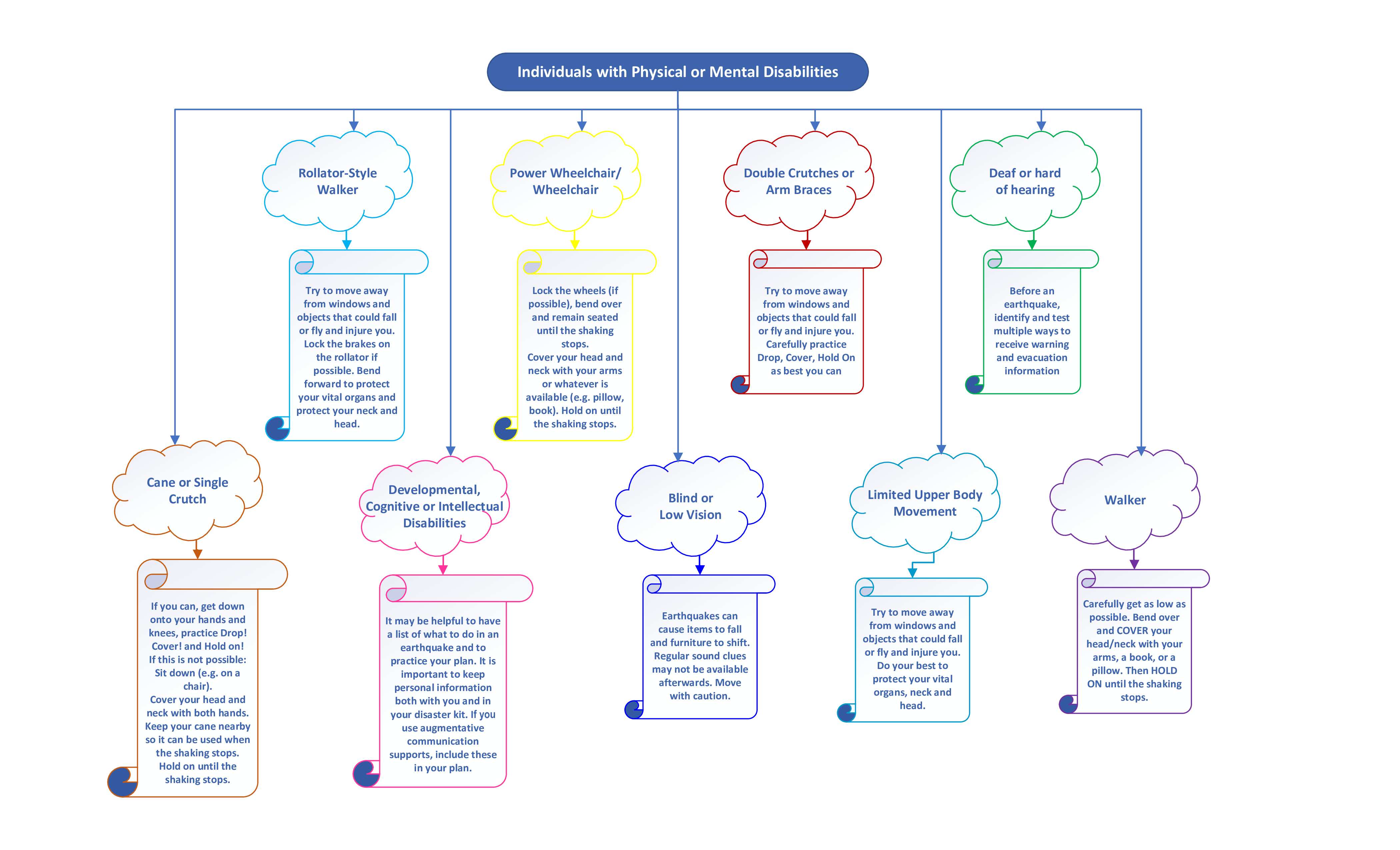
The information in the image above is compiled from recommendations listed on the ShakeOut website. (Are you registered for the next Great Oregon ShakeOut?) Their website also provides recommendations for individuals with mental or physical disabilities. This Microsoft Visio diagram below shows an additional 9 considerations provided on their website.
Here, we have another 5 scenarios to consider if you aren’t in a building when the earthquake occurs.


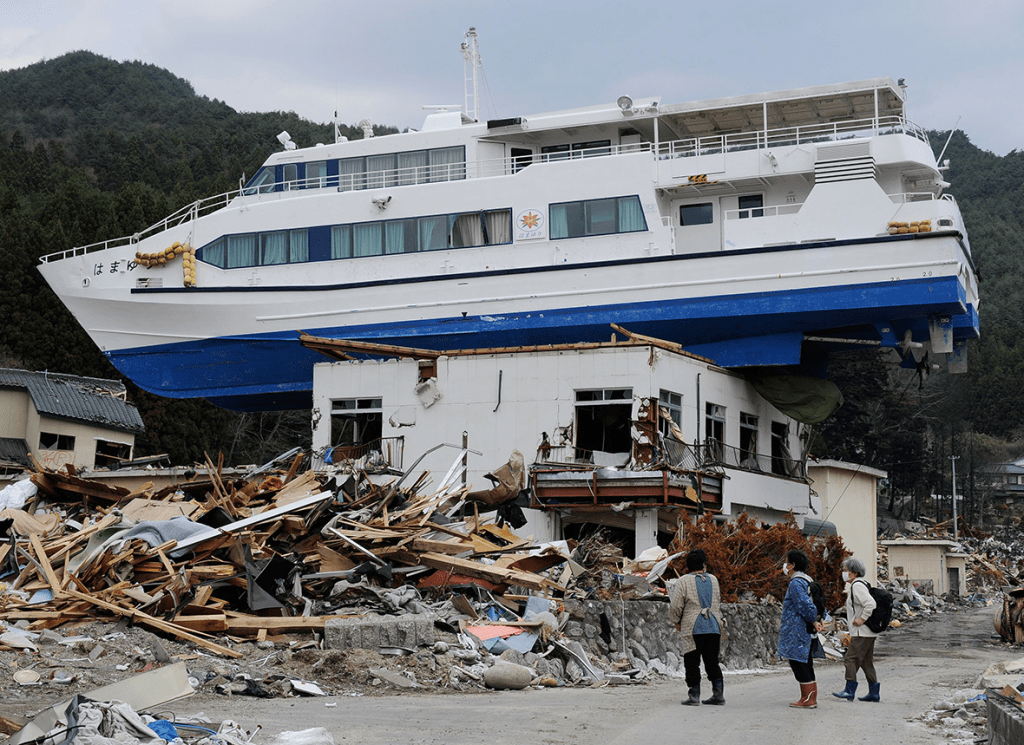
What if you are on or near a boat? The US Coast Guard recommends the following:
- If you are on land or tied up at the dock: Do not attempt to take your vessel offshore. Leave your boat and go to high ground on foot as soon as possible. You do not have time to save your boat in this situation and put your life at risk if you try to do so.
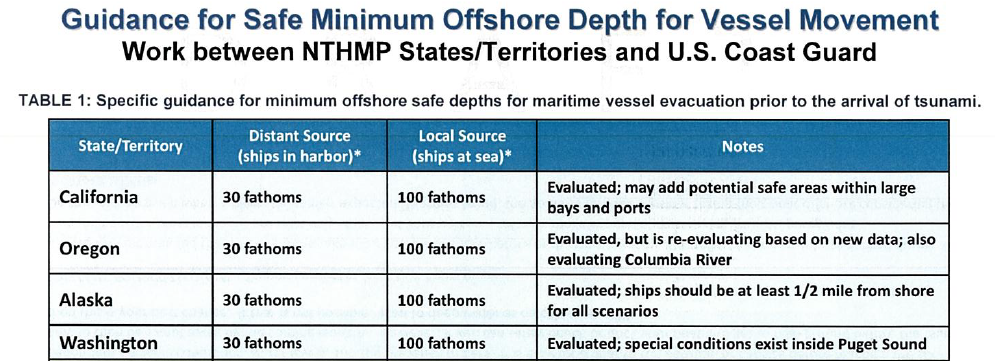
- If you are in deep water or very close to deep water: Take your vessel further offshore beyond the “minimum offshore safe depth” outlined in the Table 1 for your U.S. state/territory/commonwealth or region. Typically, this depth is SO to 100 fathoms {300 to 600 foot) depth, then you are safe from tsunamis.
- If you are on the water but very near shore: Use your best judgement to decide between the two options: safely beach/dock the vessel and evacuate to high ground or get to the minimum offshore safe depth. Attempting to beach the vessel could be challenging and dangerous, being dependent on wave conditions, water levels, and the presence of bars. It is easy for a boat to run aground or capsize before reaching the shore only to then be swept away by the coming tsunami. However, if you can safely beach or dock your boat and get to high ground before the tsunami, then this is your best chance. If that is not possible, head to deep water as quickly as possible.
Image Credit: https://www.ibtimes.co.uk/2011-earthquake-tsunami-60-powerful-photos-disaster-that-hit-japan-five-years-ago-1548255
Before diving deeper, it’s worth noting that social media has given us a window into how people actually behave when shaking starts. With the consistent messaging around Drop, Cover, and Hold On, has the messaging worked?
The University of Oregon headed a study that examined social media videos of the 2018 Anchorage, Alaska earthquake. The researchers found that, “Recommended protective action, like Drop, Cover, and Hold On, was less common as well as less timely when people experienced the Anchorage 2018 earthquake in private relative to public structures. Adults significantly delayed their own personal protective action to find children, and often made poor protective-action decisions, especially at home.”
Similar research headed by New Zealand’s Joint Centre for Disaster Research observed individual behavior during the 2011 Christchurch earthquake. It found: “The primary trans-event responses were to hold (26%) onto furniture, walls, and/or other people close to them and to look around (30%). No individuals were observed to perform all ‘Drop, Cover, Hold’ actions, the recommended action during strong earthquake shaking in New Zealand.”
It’s hard to say if the simple, clear, consistent messaging around Drop, Cover, and Hold will work when Cascadia strikes.
For those living on the coast, there is some evidence that individuals don’t always follow the protective action advice for tsunamis, either.
Following the 2023 November 17th Magnitude 6.8 and 7.4 earthquakes that struck Mindanao Island in the Philippines, Department of Science and Technology, the Philippine Institute of Volcanology and Seismology (DOST-PHIVOLCS) noted the following:
“In defiance of the advisory, social media posts showed individuals approaching the shoreline after shaking calmed, filming as the sea water receded and then returned to the shoreline. These actions are ill-advised after a strong earthquake, particularly near shorelines.”

Despite whether the advice is followed, we can see that even within the Drop! Cover! Hold On! realm of messaging, there are many actions—layers—to consider…
The question is, when should options other than DCHO be considered, especially now that ShakeAlert may be able to provide precious seconds of warning before the shaking even starts? The possibility adds yet another layer.
Check out this video that helps explain what ShakeAlert is and how it works, then visit our During the Shaking: Stay or Go page to explore when DCHO might not be the right path.
Soak in all the potentially life-saving info on DCHO by clicking these buttons. The more you learn, the better prepared you’ll be when the time comes! Don’t forget to practice!
 Surviving Cascadia